I Need to Buy My Own Scuba Diving Equipment? The Ultimate Guide to Making the Right Decision.
Breathing underwater is a privilege. And to do it with comfort, safety, and confidence, you need something essential: proper scuba diving equipment.
One of the most common questions when someone starts diving is:
Do I really need to buy my own scuba gear?
The answer depends on your level of commitment, how often you dive, and your budget.
If you’ve just been certified and the ocean has already captured your heart, you have two clear options:
- Continue using the dive center’s equipment.
- Invest in your own gear (new or second-hand).
Many divers begin by renting equipment while gaining experience. Over time, once they’re sure diving is part of their lifestyle, they gradually start purchasing their own gear.
And here’s something important:
Comfort equals safety.
And safety equals enjoyment.
When you consistently use the same equipment, your buoyancy control improves, your air consumption decreases, and your confidence grows with every dive.
What Scuba Diving Equipment Is Essential?
If you’re thinking about buying your own gear, these are the key items:
- Dive mask
- Fins
- Wetsuit
- BCD (Buoyancy Control Device)
- Regulator
- Dive computer
Let’s look at each one in detail.
1.- DIVE MASK AND FINS
Don’t shop by price. Shop by fit.
A good mask must:
- Seal perfectly
- Be comfortable
- Adapt to your face shape
A poorly fitting mask turns a dive into an uncomfortable experience full of water leaks. When the mask fits correctly, you practically forget you’re wearing it.
Fins directly affect your performance and buoyancy.
They can have positive, neutral, or negative buoyancy. The right choice depends on your kicking technique and how your body behaves underwater.
Professional advice is essential here. Don’t choose based only on design or price.
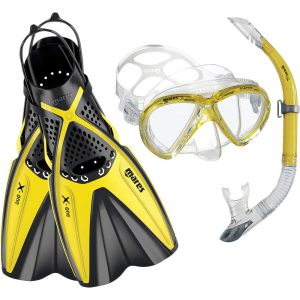
2.- Wetsuit (Wetsuit, Semi-Dry, or Dry Suit)
The right suit depends on:
- Water temperature.
- The number of dives per day.
- Your personal tolerance to cold.
General guidelines:
- Shorty → 27–28°C (80–82°F).
- 3 mm → 24–28°C (75–82°F).
- 5 mm → 19–26°C (66–79°F).
- 7 mm → 17–24°C (63–75°F).
- Semi-dry → 15–24°C (59–75°F).
- Dry suit → from 3°C (37°F).
If you do multiple dives in one day, you’ll feel progressively colder. That’s why professionals often wear thicker suits.
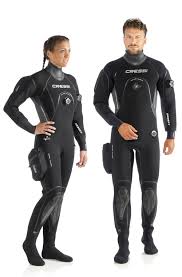
- Very stable.
- Ideal for recreational diving.
- Comfortable and easy to use.
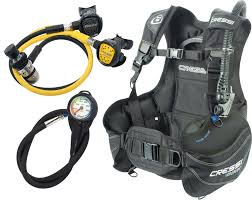
🔹 Hybrid (Back-Inflate Recreational)
- Flotation mainly on the back
- Promotes a horizontal position
- Good balance between comfort and performance
🔹 Ala (wing técnico)
- Modular and highly configurable
- Fully back-mounted flotation
- Widely used in technical diving and increasingly popular in advanced recreational diving.
Choosing the right BCD improves your trim, air consumption, and overall comfort.
4. Regulator
This is your underwater breathing system. There’s no room for compromise here.
Main types:
- Piston or diaphragm
- DIN (more common in Europe).
- Yoke or International (more common in America and Asia).
Professional recommendation:
Choose a balanced first stage.
Why?
Because it provides a smooth and consistent airflow, regardless of depth or remaining tank pressure. Breathing at 40 meters (130 feet) should feel the same as breathing at 10 meters (33 feet).
This reduces breathing fatigue and enhances safety
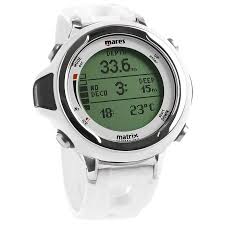
5.- DIVE COMPUTER
Today, it’s highly recommended that every certified diver owns their own dive computer.
A dive computer monitors:
• Dive time
• Depth
• Gas mix
• Surface intervals
• Water temperature
• Ascent rate
• Dive history
It warns you before entering decompression and alerts you if you ascend too quickly.
Many models include:
- Nitrox mode
- Multiple gas options
- Digital compass
- Bluetooth connectivity
- Dive planner
The more you use it, the more accurate it becomes in relation to your diving profile.
So… Should I Buy My Own Scuba Gear?
If you only dive once a year on vacation, it may not be a priority.
But if diving is part of your life…
✔️ It improves your safety
✔️ It increases your comfort
✔️ It optimizes your buoyancy
✔️ It helps you progress faster
You don’t need to buy everything at once. You can build your equipment step by step, starting with a mask, dive computer, or regulator.
Because scuba gear is not just equipment.
It’s confidence.
It’s control.
It’s progression.
And when you feel comfortable underwater… you truly begin to enjoy diving. 🌊.
Carlos Campaña
03/03/26
¿Dónde Estamos?
C.C. Papagayo, Avenida de Papagayo 18, local 67D
35580 Playa Blanca
Lanzarote – Islas Canarias
+34 690 80 85 08
+34 928 51 72 77
info@lanzarotenonstopdivers.com
Lanzarote Non Stop Divers
Centro de buceo en Lanzarote.
Salidas diarias, cursos de buceo de todos los niveles.
Alquiler de equipos de buceo